Many businesses fall into the trap of tracking “vanity metrics.” They check their website traffic once a month, celebrate a high number of raw page views, and wonder why sales remain flat. In digital marketing, one of the most misunderstood data points is the humble click.
A click is not just a binary event. It is not merely a number that increments by one. When a real person clicks on your short link, they send a packet of highly valuable, contextual data. By learning how to read, interpret, and act upon this information, you can transform simple traffic into paying customers.
In this guide, we dive deep into the mechanics of link analytics, showing you how to dissect referral sources, device types, geolocations, and time-based patterns to optimize your marketing funnels.
1. Clicks Under the Microscope: Total vs. Unique
The first step in reading link analytics is understanding the difference between Total Clicks and Unique Clicks.
- Total Clicks: The raw count of every time a link was clicked. If one user clicks a link five times to re-read your sales page, it registers as five total clicks.
- Unique Clicks: The number of individual visitors who interacted with your link. This is tracked using cookies, session IDs, or IP addresses. In the same scenario, this would count as only one unique click.
Why the Gap Matters
A huge disparity between total and unique clicks is a key indicator of user behavior. If your link has 1,000 total clicks but only 100 unique clicks, it means a small group of people is highly interested—clicking multiple times to reference your content. Conversely, it could indicate bot traffic or automated crawlers (like search engine bots indexers or social platform preview scrapers) repeatedly visiting your link.
When evaluating campaign success, always optimize for Unique Clicks to assess true audience reach, and analyze Total Clicks to measure engagement depth.
2. Deciphering Referral Sources & UTM Parameters
A referrer header is a piece of data sent by the browser indicating the previous webpage the user was on before clicking your link. For example, if a user clicks a link on Facebook, the referrer header will point to facebook.com.
However, modern privacy settings and HTTPS-to-HTTP migrations often strip referrer headers, resulting in a large volume of “Direct” or “Unknown” traffic. To combat this, you should use UTM (Urchin Tracking Module) parameters.
UTM parameters are query tags appended to the end of your destination URL. When a short link redirects, it passes these tags to your analytics suite:
# Python script to analyze query parameters and print traffic sources
import urllib.parse

def parse_link_parameters(redirect_url):
    parsed_url = urllib.parse.urlparse(redirect_url)
    query_params = urllib.parse.parse_qs(parsed_url.query)

    # Extracting source, medium, and campaign safely
    # Note: We use & in code blocks to prevent HTML rendering bugs
    source = query_params.get('utm_source', ['unknown'])[0]
    medium = query_params.get('utm_medium', ['unknown'])[0]
    campaign = query_params.get('utm_campaign', ['unknown'])[0]

    print(f"Traffic Attribution Report:")
    print(f" - Source: {source}")
    print(f" - Medium: {medium}")
    print(f" - Campaign: {campaign}")

# Example of a redirect URL with UTM tags
sample_url = "https://linkzip.uk/promo?utm_source=newsletter&utm_medium=email&utm_campaign=summer_sale"
parse_link_parameters(sample_url)
By tracking UTMs through your short URLs, you eliminate the mystery of “Unknown” traffic and know exactly which campaign drove the click.
3. Device and Browser Intelligence
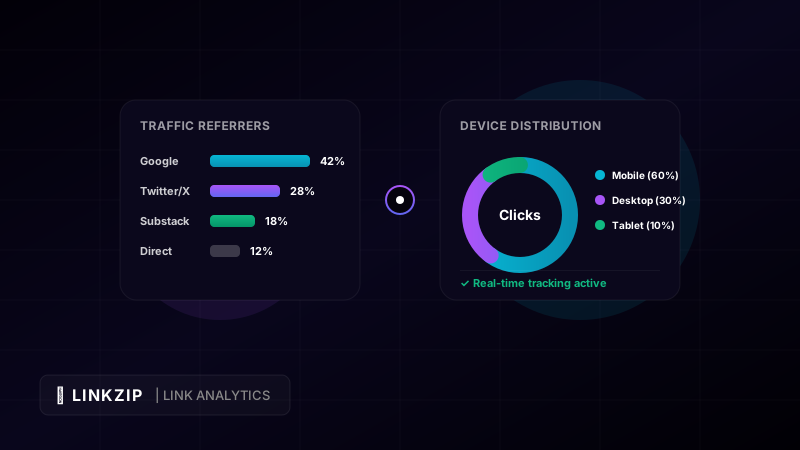
Optimizing your website design without reviewing device analytics is a recipe for low conversions. Link analytics reveal the device category (Mobile, Desktop, Tablet), operating system (iOS, Android, Windows, macOS), and browser (Chrome, Safari, Firefox) of every visitor.
Actionable Optimization Steps:
- Mobile vs. Desktop Split: If your data shows 80% mobile users, but your landing page has complex hover effects, large image files, or multi-step checkout forms, you are actively losing customers. Simplify your mobile checkout to increase conversion.
- Operating System Insights: iOS users historically spend more per purchase than Android users. If a high percentage of clicks come from iOS, highlight premium pricing tiers or Apple Pay options.
- Browser Diagnostics: If you notice a high bounce rate from users on Safari compared to Chrome, your website might have rendering or layout bugs on WebKit. Run browser-testing tools to verify layout stability.
4. Geolocation: Localizing the User Experience
Every IP address is tied to an internet service provider and a physical location. LinkZip maps these IPs to country and city data in real time, presenting you with a geographical heat map of your audience.
This data is crucial for two main reasons:
A. Localization of Offers
If you are running a global e-commerce brand and see a spike in clicks from Germany, you can translate your landing page, offer payment options like Sofort, and calculate shipping costs in Euros.
B. Timezone-Sensitive Campaigns
If you have a large audience in Tokyo and another in New York, sending an email campaign at a single time means one audience will receive it while sleeping. Use geolocation statistics to segment your broadcast times.
5. Temporal Patterns: The Clockwork of Clicks
By logging the exact timestamp of every click, link analytics reveal hourly and weekly patterns.
- Hourly Spikes: Do users click your links during their morning commute (7:00 AM - 9:00 AM) or after dinner (8:00 PM - 10:00 PM)?
- Weekly Trends: Does B2B content perform best on Tuesday mornings, while lifestyle content spikes on Sunday afternoons?
Aligning your social media posts, newsletter sends, and paid ads with these temporal peaks ensures that your content appears at the top of feeds when your audience is most active, driving up click-through rates.
6. Vanity Metrics vs. Actionable Link Analytics
Understanding the difference between superficial numbers and valuable insights is key to successful digital marketing.
| Vanity Metric | Actionable Insight | Business Decision / Action |
|---|---|---|
| 10,000 Total Clicks | 2,100 Unique Clicks | Identifies bot traffic or high-frequency repeat clicks. Adjust fraud settings. |
| High Referral Count | Poor Mobile Conversion | Mobile pages load too slowly or form is too complex. Redesign mobile checkout flow. |
| High Global Traffic | Surge in German visitors | Traffic is arriving from outside local shipping zones. Translate site or add international shipping. |
| Constant Daily Hits | Peak click activity at 8 PM | Posts are lost in feeds when shared in mornings. Move posting schedule to evening hours. |
7. A/B Testing Using Dynamic Redirects
Advanced marketers use link analytics to perform split redirection tests. Instead of sending 100% of your traffic to a single landing page, you can set your tracking link to dynamically split traffic:
- 50% of Clicks: Route to
yourdomain.com/landing-page-a - 50% of Clicks: Route to
yourdomain.com/landing-page-b
By monitoring the conversion data on each page in relation to the initial click data, you can scientifically determine which layout, copy, or price point generates the highest revenue.
8. Frequently Asked Questions (FAQ)
Are link analytics GDPR compliant?
Yes, provided the data collection respects user privacy. Branded link shorteners like LinkZip analyze geolocation and device metrics by processing IP addresses in memory to determine country/city levels and device categories without storing complete, identifiable IP records or tracking personal information without consent.
How do search engines view shortened link redirects?
Most premium shorteners use 301 Redirects (Moved Permanently) or 302 Redirects (Found). 301 redirects pass 90-99% of search engine link equity (SEO authority) to the destination page, meaning your analytics tracking won’t harm your search rankings.
What is dark social traffic?
Dark social refers to link sharing that cannot be tracked by traditional web analytics. This includes links shared in private messaging apps (WhatsApp, Slack, Discord, Messenger) or native mobile apps. Using unique tracking shortlinks is the best way to shine a light on dark social shares.
Pro Tip: Long, complicated links reduce user trust and lower click-through rates. Use a free link management tool like LinkZip.uk to clean up your links, customize your aliases, and track clicks in real-time.
Conclusion
Data is the lifeblood of digital business, but raw numbers are useless without interpretation. By monitoring unique clicks, tracking traffic origins via UTM parameters, analyzing device preferences, and understanding temporal peaks, you convert simple links into powerful data collection nodes. Log into your LinkZip.uk dashboard, examine your click trends, and start making decisions based on real user behavior.